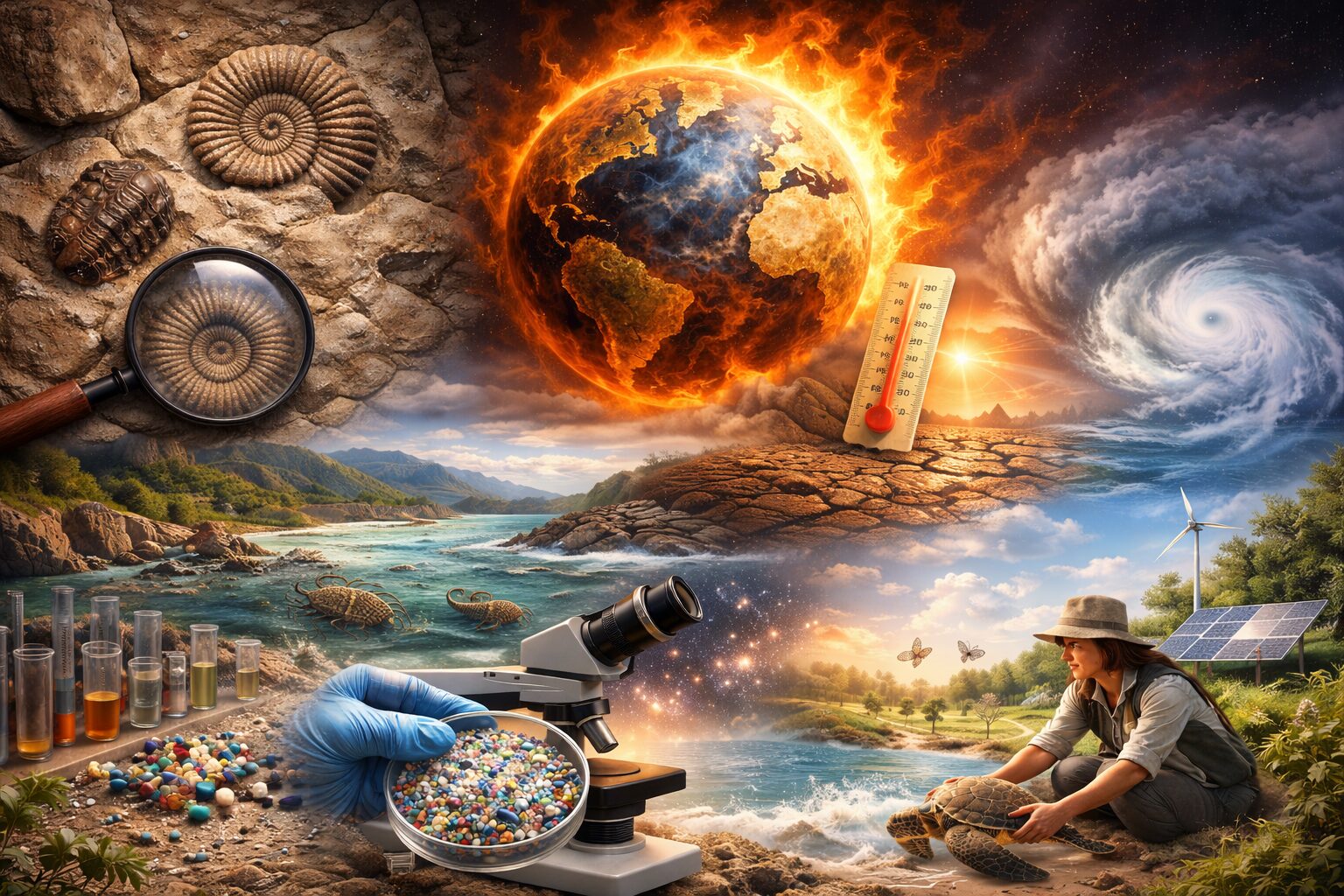
A range of scientific findings and environmental reports published this week are shaping public discussion about Earth’s changing natural systems, species survival, and how research is conducted. These developments span paleontology, global temperature records, plastics science and emerging positive environmental stories from 2025.
Fossil Research Reveals Extinction Risks
New research led by the University of Oxford suggests that the physical layout of ancient coastlines played a major role in marine species’ susceptibility to extinction over the past 540 million years. Specifically, organisms living along broad, east-west oriented continental shelves — such as those similar to today’s Mediterranean and Gulf of Mexico — tended to have higher extinction risk compared with those on north-south oriented coastlines. This kind of work helps scientists understand long-term biodiversity patterns and how geography intersects with climate shifts over geological time.
2025 Among Hottest Years on Record
Scientists analyzing data from global climate monitoring agencies report that 2025 ranked as the third-warmest year on record, continuing a trend of exceptionally high global temperatures in the early 2020s. Persistent warmth is linked with intensified weather extremes — including more powerful heat waves, storms and precipitation events — as the planet continues to respond to accumulated atmospheric heat.
These ongoing climate trends have prompted discussion within the scientific community about further refining climate models and improving understanding of their possible impacts on ecosystems and human societies.
Microplastics Research Faces New Scrutiny
Recent scientific scrutiny has cast doubt on some high-profile studies claiming that microplastics permeate various human tissues. While environmental plastic pollution is widely documented across the world’s oceans, soils and air, a number of scientists warn that reports of microplastic particles inside human organs may stem from laboratory contamination or analytical error.
Experts emphasize that plastic pollution remains a significant environmental issue, but determining its exact effects on human health requires more rigorous methods and replication to avoid premature conclusions.
Stories of Hope and Innovation
Amid these scientific updates, journalists and researchers alike are highlighting positive environmental developments from 2025 to balance urgent concerns. Innovations in conservation, unusual ecological discoveries and advances in sustainability research were showcased in year-end retrospectives, reminding readers that scientific inquiry often yields insights that support resilience and adaptation.
What’s Next in Science
Beyond these headlines, ongoing scientific work — from climate monitoring and space exploration to biodiversity and materials science — continues to produce discoveries that deepen understanding of Earth and the universe. Independent science publications and research institutions are releasing monthly findings on topics such as hidden climate gas cycles, unusual astronomical events, and novel biological mechanisms.
Questions for Readers
- How do you think scientific understanding of climate trends should shape future research priorities?
- What role should independent verification play in publishing high-impact environmental health studies?
- In what ways can science journalism help the public understand complex environmental science?